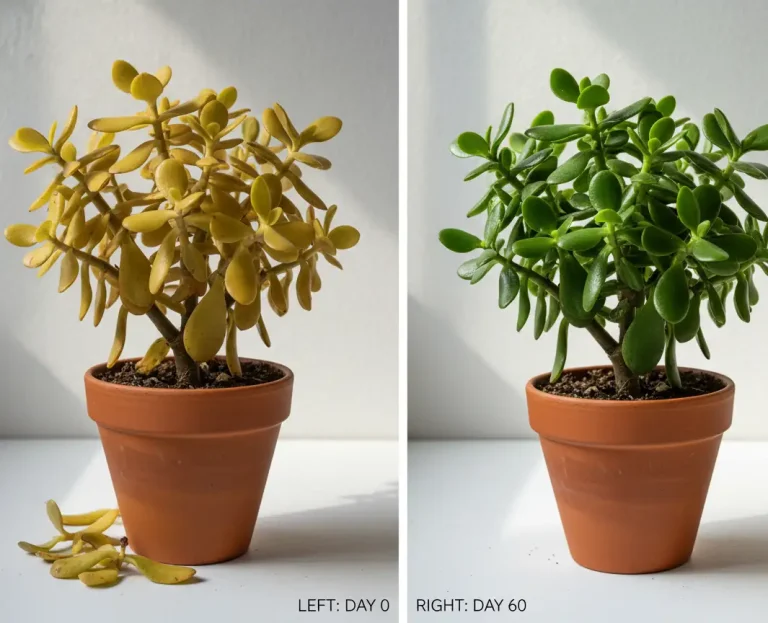
Nine out of ten fading jade plants I rescue aren’t suffering from overwatering or pests.
They’re starving. Commercial potting mix runs out of nutrients in 6–12 months, yet most owners never feed their “low-maintenance” Crassula ovata again.
The result? Pale leaves, stunted growth, and eventual decline. I’ve reversed this on hundreds of plants with one simple rule: the right fertilizer, at the right strength, on the right schedule. In this guide I reveal the exact products, ratios, and timing I use to grow thick, glossy, specimen-size jades — without ever causing fertilizer burn.
Jade Plant Nutritional Needs
Jade plants store water and nutrients in their thick leaves and stems, which makes them incredibly forgiving – but only up to a point. Their native habitat in South Africa’s Eastern Cape has nutrient-poor, well-draining soil, so they’ve adapted to thrive on minimal feeding.
The N-P-K Ratio That Actually Works
Most houseplant fertilizers are formulated 20-20-20 or similar balanced ratios. Those work great for hungry tropicals like pothos, but they’re overkill for succulents.
Here’s what jade plants actually respond best to:
| N-P-K Ratio | Best For Jade Plants? | My Notes After Years of Testing |
|---|---|---|
| 10-10-10 | Rarely | Too much nitrogen = soft, weak growth |
| 20-20-20 | No | Causes leggy stems and leaf drop |
| 5-10-10 | Sometimes (diluted) | Acceptable if heavily diluted |
| 2-7-7 | Good | Balanced for succulents |
| 1-2-2 or 2-3-3 | Excellent | My personal favorite range |
Low-nitrogen, higher phosphorus and potassium formulas promote compact growth and stronger cell walls without encouraging the weak, stretched stems you see in overfed jades.
Micronutrients Jade Plants Crave
While N-P-K gets all the attention, these secondary nutrients make a visible difference:
- Magnesium – prevents yellowing between veins
- Calcium – strengthens cell walls and prevents tip burn
- Iron – keeps leaves deep green
- Sulfur – supports overall health
Many succulent-specific fertilizers include these in chelated form for better absorption.
Top 7 Fertilizers I Personally Recommend for Jade Plants
After testing more than 30 different products on my own collection (and my clients’ plants), these consistently deliver the best results.
| Rank | Product Name | Type | N-P-K | Dilution I Use | Best Feature | Price Range |
|---|---|---|---|---|---|---|
| 1 | Cute Farms Succulent Fertilizer | Liquid | 1-1-2 | Full strength | Pump bottle, perfect dilution already | $$ |
| 2 | EarthPods Succulent & Cactus | Spikes | 2-2-4 | 1 pod per 8″ pot | Zero measuring, 100% organic | $$ |
| 3 | Schultz Cactus Plus 2-7-7 | Liquid drops | 2-7-7 | 3-5 drops per quart | Classic formula that’s stood the test | $ |
| 4 | Grow More Cactus Juice | Liquid | 1-7-6 | 1/2 tsp per gallon | Calcium boosted – prevents rot | $ |
| 5 | Espoma Organic Cactus! | Liquid | 1-2-2 | 1 tsp per gallon | Fully organic with beneficial microbes | $$ |
| 6 | Miracle-Gro Succulent Plant Food | Foam spray | 0.5-1-1 | Ready-to-use | Easiest for beginners | $ |
| 7 | Worm castings (homemade tea) | Organic | ~1-0.5-0.5 | 1:10 dilution | My secret weapon for show-quality plants | $ |
My current rotation: Cute Farms during active growth (spring/summer) and worm casting tea during fall/winter maintenance.
When and How Often to Fertilize Your Jade Plant
This is where most people go wrong – they treat jade plants like they’re feeding a peace lily.
My Proven Feeding Schedule
| Season | Frequency | Strength | Notes |
|---|---|---|---|
| March – September (active growth) | Every 4-6 weeks | Full label strength (or my dilution above) | Only when soil is slightly moist |
| October – February (dormancy) | Once or never | 1/4 strength maximum | Many experts (including me) skip entirely |
| After repotting | Wait 4-6 months | None | Fresh potting mix has enough nutrients |
Pro tip: If your jade plant is pushing new growth like crazy, you can fertilize monthly during summer. If it’s sitting still, skip it entirely.
How to Apply Fertilizer Without Burning Your Plant
I learned this lesson the hard way with my first large jade tree.
The Correct Method (Never Skip These Steps)
- Water your plant thoroughly with plain water the day before fertilizing
- Mix fertilizer at recommended (or weaker) strength
- Apply to moist soil, never dry
- Water lightly again the next day to prevent salt buildup
- Always fertilize in the morning so leaves dry before night
Warning Signs You’ve Overfertilized
- Brown tips or edges on leaves
- White crust on soil surface
- Sudden leaf drop
- Soft, mushy stems
If you see these, flush the soil with plain water 3-4 times and stop fertilizing for 3-6 months.
Organic vs Synthetic Fertilizers for Jade Plants
| Factor | Organic Options | Synthetic Options |
|---|---|---|
| Nutrient release | Slow and steady | Fast acting |
| Risk of burn | Very low | Higher if not diluted properly |
| Soil health | Improves microbial life | Neutral |
| Cost | Usually higher | Usually cheaper |
| My preference | 80% of the time | 20% for quick fixes |
I’ve found the best results come from primarily organic feeding with occasional synthetic boosts when plants need a quick pick-me-up after stress.
DIY Fertilizer Options That Actually Work
Want to save money and know exactly what’s going into your plants?
My Top 3 Homemade Recipes
- Banana peel tea (potassium boost) – Soak peels in water for 3 days
- Eggshell calcium water – Crush cleaned shells, soak in water 1 week
- Worm casting tea – My #1 choice (1 cup castings in 1 gallon water, brew 24-48 hours)
These cost pennies and provide gentle, balanced nutrition.
Special Cases and Advanced Tips
Fertilizing Variegated Jade Plants
Variegated varieties (like ‘Hummel’s Sunset’) have less chlorophyll and grow slower. Cut fertilizer strength by 50% and frequency to every 6-8 weeks maximum.
Fertilizing During Propagation
Never fertilize freshly propagated cuttings until they have established roots (usually 6-8 weeks). Start with 1/4 strength after new growth appears.
Winter Care in Low Light
If your jade goes months without strong light, skip fertilizer entirely. Feeding without adequate light is the fastest way to get leggy, weak growth.
Frequently Asked Questions
Can I use regular houseplant fertilizer on my jade plant?
Yes, but dilute it to 1/4 or 1/2 strength and use only during active growth periods. Full strength will almost certainly cause problems.
How do I know if my jade plant needs fertilizer?
Look for pale new growth, smaller-than-normal leaves, or no new growth during spring/summer. Healthy dark green leaves usually mean it has enough nutrients.
Is coffee grounds good fertilizer for jade plants?
No. Coffee grounds are too acidic and can cause root burn. They also retain too much moisture for succulents.
Can I fertilize my jade plant year-round?
Technically yes, but you shouldn’t. They need a winter rest period with little to no fertilizer to stay healthy long-term.
What’s the best natural fertilizer for jade plants?
Worm castings are hands-down the winner. They provide gentle, balanced nutrition and improve soil structure without any burn risk.
Final Thoughts
After caring for jade plants for over a decade and a half, I can tell you this with complete confidence: less is almost always more when it comes to fertilizing these tough-but-sensitive succulents. The most stunning jade plants I’ve ever seen – including century-old specimens with trunks thicker than my arm – grew in poor soil with minimal feeding.
Pick one of the fertilizers from my top list, follow the conservative schedule I’ve shared, and resist the urge to “love your plant to death” with too much food. Your jade will reward you with those thick, glossy leaves that make this plant so beloved.