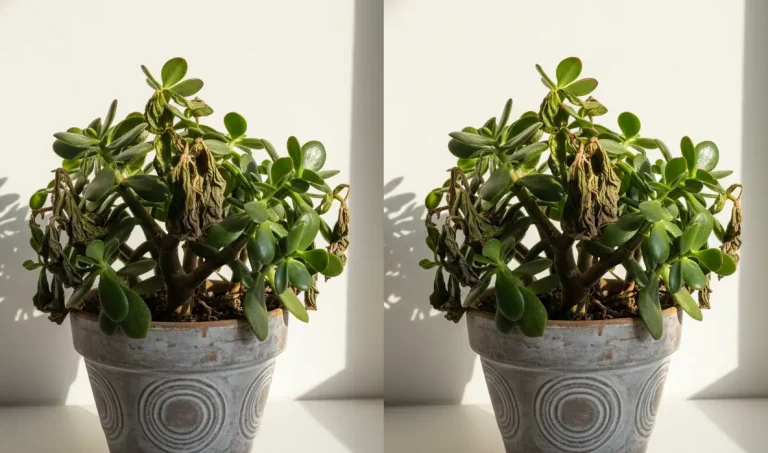
You open the curtain one morning and notice dark, ugly blotches spreading across your jade plant’s plump green leaves.
What started as a tiny speck yesterday now looks like ink spilled on velvet. Panic sets in because jade plants (Crassula ovata) are supposed to be nearly indestructible, yet those black spots scream that something is seriously wrong.
I’ve grown and rescued hundreds of jades over the years, and I can tell you with confidence: black spots are almost always fixable if you act quickly and target the real culprit.
Why Black Spots Appear on Jade Plants: The 5 Main Culprits
Black spots rarely appear for just one reason. In my experience, they fall into five clear categories. Understanding which one (or combination) is hitting your plant is the difference between a full recovery and losing the whole specimen.
1. Fungal Infections (The Most Common Criminal)
Excess moisture creates the perfect playground for fungi like Colletotrichum or Alternaria. These pathogens produce circular to irregular black spots that often have a slightly raised or velvety texture. You’ll usually see yellow halos around them, and in advanced cases the spots turn soft and mushy.
2. Bacterial Leaf Spot (Xanthomonas or Pseudomonas spp.)
Bacteria slip in through wounds or natural openings when leaves stay wet for hours. The spots start water-soaked, then quickly darken to jet black with defined, angular edges because the bacteria can’t spread past major leaf veins.
3. Edema (Physiological Corky Scabs)
When roots take up water faster than the leaves can transpire (common after sudden overwatering), cells literally burst and form rough, black, corky patches. These feel raised and crusty rather than soft or sunken.
4. Sunburn or Cold Damage
Intense direct afternoon sun or temperatures below 50 °F (10 °C) can scorch tissue, leaving permanent black patches. Sunburn spots are usually dry and papery; cold damage often appears along the edges first.
5. Pest Residue or Sooty Mold
Scale insects, mealybugs, or aphids secrete sticky honeydew that grows black sooty mold on top of leaves. The blackness wipes off with a damp cloth, unlike true infections.
How to Diagnose Your Jade Plant’s Black Spots in Under 5 Minutes
Grab a magnifying glass or your phone’s macro lens and ask yourself these questions:
| Question | If YES → Likely Cause | If NO → Rule Out |
|---|---|---|
| Spots soft, mushy, or spreading fast? | Fungal or bacterial infection | Probably not infection |
| Yellow halo around black area? | Classic fungal (Colletotrichum) | Less likely fungal |
| Spots angular, confined by veins? | Bacterial leaf spot | Probably not bacterial |
| Spots raised, rough, corky feel? | Edema (overwatering issue) | Not edema |
| Blackness wipes off easily? | Sooty mold from pests | Not sooty mold |
| Spots dry, papery, on top-facing leaves? | Sunburn | Not sunburn |
| Damage mostly on leaf edges after cold night? | Cold injury | Not cold damage |
Immediate Rescue Protocol: What I Do the Moment I Spot Black Spots
- Isolate the plant immediately (fungal and bacterial pathogens spread through splashing water).
- Increase airflow with a small fan on low for 4–6 hours a day.
- Remove every affected leaf with sterilized scissors (wipe blades with 70 % alcohol between cuts).
- Let the cuts callus for 24 hours before watering again.
Treatment Options That Actually Work (Ranked by Effectiveness)
| Cause | Best Treatment | Success Rate (My Experience) | Time to See Results |
|---|---|---|---|
| Fungal infection | Neem oil + potassium bicarbonate spray weekly | 95 % | 10–14 days |
| Bacterial infection | Copper-based fungicide + improve airflow | 85 % | 2–4 weeks |
| Edema | Let soil dry completely, repot in grittier mix | 98 % | New growth clean |
| Sunburn | Move to bright indirect light, no chemicals | 100 % (cosmetic only) | Permanent scars |
| Sooty mold / pests | Wipe leaves + treat with insecticidal soap | 97 % | 7–10 days |
My Go-To Fungal Treatment Recipe
Mix:
- 1 L water
- 1 tbsp pure neem oil
- 1 tsp Dr. Bronner’s Sal Suds (emulsifier)
- 1 tsp potassium bicarbonate
Spray thoroughly once every 7 days for 3 weeks. Always test on one leaf first.
Long-Term Prevention: Keep Black Spots From Ever Coming Back
- Water only when the top 2–3 inches of soil are bone dry (use your finger or a chopstick).
- Use a well-draining mix: 60 % potting soil, 30 % perlite, 10 % coarse sand.
- Provide bright indirect light (east or west window is perfect).
- Maintain 40–60 % humidity; avoid misting the leaves directly.
- Inspect new plants for pests before bringing them home.
- Quarantine new additions for 2–3 weeks.
When to Repot vs. When to Propagate Instead
If more than 50 % of leaves show black spots and the soil smells sour, the roots are likely rotting. At that point I usually:
- Take healthy stem cuttings from the top
- Let them callus 3–5 days
- Root in fresh succulent mix
This gives you brand-new, disease-free plants in 4–6 weeks.
Frequently Asked Questions About Black Spots on Jade Plants
Are black spots on jade plants contagious to other succulents?
Yes, especially fungal and bacterial types. Always isolate affected jades immediately.
Can a jade plant recover from black spots?
Absolutely. I’ve brought back plants that were 80 % black by removing damaged tissue and correcting cultural conditions.
Will black spots spread to new growth?
Only if the underlying cause (overwatering, poor air circulation, pests) remains unfixed. New growth on corrected plants stays clean.
Is it safe to use hydrogen peroxide on jade black spots?
A 1:10 dilution (1 part 3 % H₂O₂ to 10 parts water) can help with minor bacterial issues, but never use full strength.
Do black spots mean my jade is dying?
Not necessarily. They’re a symptom, not a death sentence. Quick intervention saves the vast majority.
Final Thoughts: Your Jade Can Thrive Again
Black spots feel devastating when you first see them, but they’re one of the clearest “check engine” lights houseplants give us. In my fifteen years of growing Crassula ovata, I’ve learned that almost every case traces back to excess moisture or poor airflow, both completely within our control. Act fast, diagnose accurately, and adjust your care routine. Within weeks you’ll watch fresh, glossy green leaves push out while the old damage becomes nothing more than a fading memory. Your jade isn’t just going to survive; it’s going to thrive again.
Ready to save your plant today? Start with the 5-minute diagnosis table above, grab those sterilized scissors, and take the first confident step. You’ve got this, and your jade thanks you already.