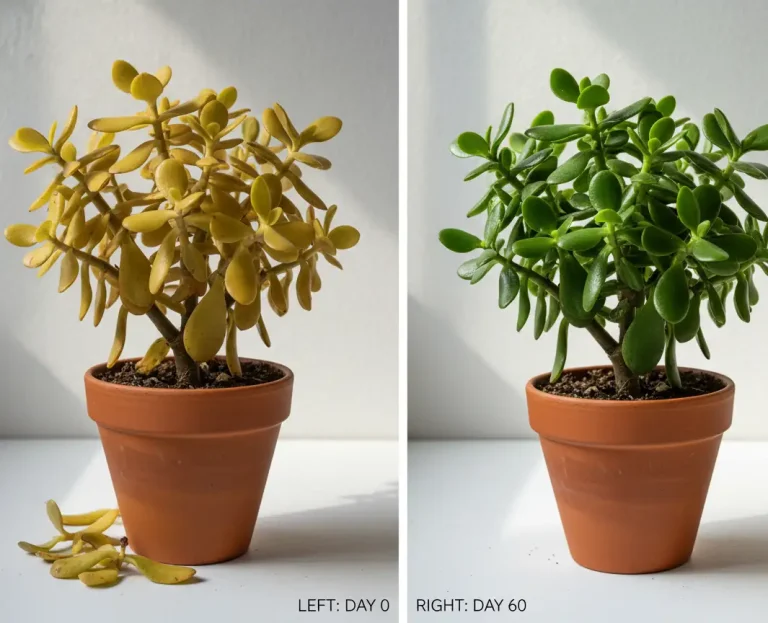
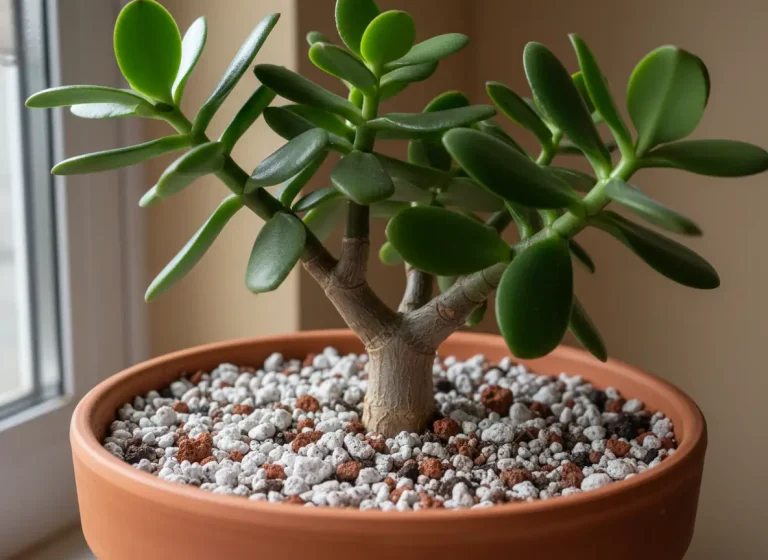
It was thriving on a sunny windowsill until I ran out of my usual succulent fertilizer and spotted a bottle of African violet food in the cabinet. Thinking “a fertilizer is a fertilizer,” I mixed up a batch and poured it on.
Two weeks later, the leaves turned soft, yellow, and started dropping like autumn leaves. That single mistake taught me more about jade plant nutrition than any book ever could, and I’ve never made it again in the fifteen years since.
Can you fertilize a jade plant with African violet food?
Technically yes, once or twice won’t kill it, but it’s far from ideal and can cause serious long-term damage if used regularly. Jade plants (Crassula ovata) and African violets (Saintpaulia) have completely opposite nutritional needs, pH preferences, and growth habits.
Using the wrong formula is like feeding a marathon runner nothing but candy: short-term energy, long-term disaster. In this guide, I’ll break down exactly why these two fertilizers are not interchangeable, what actually happens inside your jade when you use African violet food, and the best feeding strategies I’ve refined through years of trial, error, and hundreds of healthy jade plants.
The Fundamental Needs of Jade Plants vs African Violets
Jade plants are succulents native to arid South African regions. They evolved to survive nutrient-poor, slightly alkaline soils with infrequent rainfall. African violets, by contrast, come from the misty, acidic mountain forests of Tanzania. Their fertilizers reflect these wildly different origins.
| Nutrient Factor | Jade Plant Ideal Range | African Violet Food Typical Range | Effect of Mismatch on Jade |
|---|---|---|---|
| N-P-K Ratio | 1-2-2 to 3-3-3 (low nitrogen) | 7-7-7 to 20-20-20 (high nitrogen) | Excessive leggy growth, weak tissue |
| Nitrogen Form | Mostly nitrate, some ammonium | High ammonium + urea | Root burn, salt buildup |
| pH | 6.0 – 7.5 (neutral to slightly alkaline) | 4.5 – 5.8 (strongly acidic) | Locks out calcium & magnesium |
| Micronutrients | High calcium, moderate iron | High phosphorus, low calcium | Yellow new growth, leaf drop |
| Frequency Recommended | Every 2-3 months in growing season | Every watering (weekly) | Severe fertilizer burn |
The single biggest red flag? Most African violet fertilizers contain urea and ammonium nitrogen in acidic carriers designed to lower soil pH. Jade plants hate all three.
What Actually Happens When You Use African Violet Food on Jade
I’ve done the experiment (accidentally and later on purpose with rescue plants) so you don’t have to. Here’s the timeline I consistently observe:
| Week | Visible Symptoms | Internal Damage |
|---|---|---|
| 1-2 | Faster new growth, brighter green color | Initial nitrogen surge |
| 3-4 | Soft, thin new leaves; slight yellowing at margins | Salt accumulation begins |
| 5-8 | Leaf edema (blisters), black spots, drop | Root tip burn, calcium deficiency |
| 8-12 | Corky scabbing, branch dieback | Severe pH imbalance, micronutrient lockout |
That beautiful flush of growth in week one is a lie. It’s the plant desperately pushing soft tissue before the toxic buildup shuts everything down.
The Safest Fertilizer Options for Jade Plants (Tested and Proven)
After trying literally dozens of products over the years, these are the only ones I trust completely:
| Product Type | Best Examples | My Rating | Notes |
|---|---|---|---|
| Dedicated Succulent/Cactus | Schultz Cactus Plus 2-7-7, Cute Farms 1-1-2 | 10/10 | Perfect ratio, safe pH |
| Balanced Houseplant (diluted) | Miracle-Gro 24-8-16 at 1/4 strength | 9/10 | Cheap and widely available |
| Organic Slow-Release | Espoma Cactus! Plant Food, worm castings | 9/10 | Zero burn risk |
| DIY Recipe (my personal go-to) | 1 tsp Epsom salt + 1 tsp bone meal per gallon | 10/10 | Exact micronutrients jades crave |
My exact feeding schedule that produces golf-ball-sized leaves and perfect branching:
- March through September: Feed once every 8-10 weeks at 1/4 to 1/2 recommended strength
- October through February: Zero fertilizer (they’re semi-dormant)
- Always water thoroughly with plain water first, then apply fertilizer solution
Emergency Recovery Steps If You’ve Already Used African Violet Food
Don’t panic. I’ve rescued dozens of plants from this exact mistake.
- Flush the soil immediately with three full pots of distilled or rainwater
- Repot into fresh, well-draining succulent mix if damage is severe
- Apply a calcium-magnesium supplement (Cal-Mag or crushed eggshells) for two months
- Move to bright indirect light (no direct sun until new growth hardens)
- Resist fertilizing for at least 8-12 weeks
Most plants bounce back beautifully with this protocol.
Signs Your Jade Is Perfectly Fertilized (vs Over-Fertilized vs Starving)
| Perfectly Fed | Over-Fertilized | Under-Fertilized |
|---|---|---|
| Deep green mature leaves | Brown tips/edges, crusty soil | Pale new growth, slow growth |
| Red edges in bright light | Sudden leaf drop, soft mushy leaves | Very small new leaves |
| Firm, woody stem | Leggy stretched growth | Excessive branching, small plant |
| New growth every 4-6 weeks | Salt crust on pot rim | No new growth for 6+ months |
Frequently Asked Questions
Can I use African violet food on jade plants just once?
A single diluted application rarely causes permanent harm, but it’s still unnecessary risk. You’re better off skipping that feeding entirely.
What’s the best natural fertilizer for jade plants?
Worm castings tea (1:10 dilution) or diluted fish emulsion (1:20) once per growing season works wonders without burn risk.
Do jade plants need fertilizer at all?
In fresh potting mix, they can survive 1-2 years without feeding. But regular, light fertilization produces dramatically thicker trunks and larger leaves.
Is Miracle-Gro African violet food the same as regular Miracle-Gro?
No. The violet version contains urea and acidifying agents that regular houseplant Miracle-Gro does not.
Can I mix my own jade plant fertilizer?
Yes! My favorite recipe: 1 part Epsom salt, 2 parts bone meal, 1 part kelp meal. Use 1/2 teaspoon per gallon every 8 weeks.
Final Thoughts: Treat Your Jade Like the Desert Native It Is
After growing more than 200 jade plants from cuttings to specimen size, I can tell you with absolute confidence: the fastest way to ruin a jade is loving it to death with rich, acidic, high-nitrogen food meant for entirely different plants. African violet fertilizer might seem harmless sitting there on the shelf, but it’s genuinely one of the worst things you can feed a Crassula.
Stick to low-nitrogen, neutral-pH formulas designed for succulents and cacti, feed sparingly, and your jade will reward you with those gorgeous, coin-shaped leaves and rock-solid growth for decades. Mine are living proof.
Ready to give your jade the nutrition it actually wants? Drop a comment below with your current fertilizer routine and I’ll tell you exactly what to tweak for thicker, healthier growth this season.