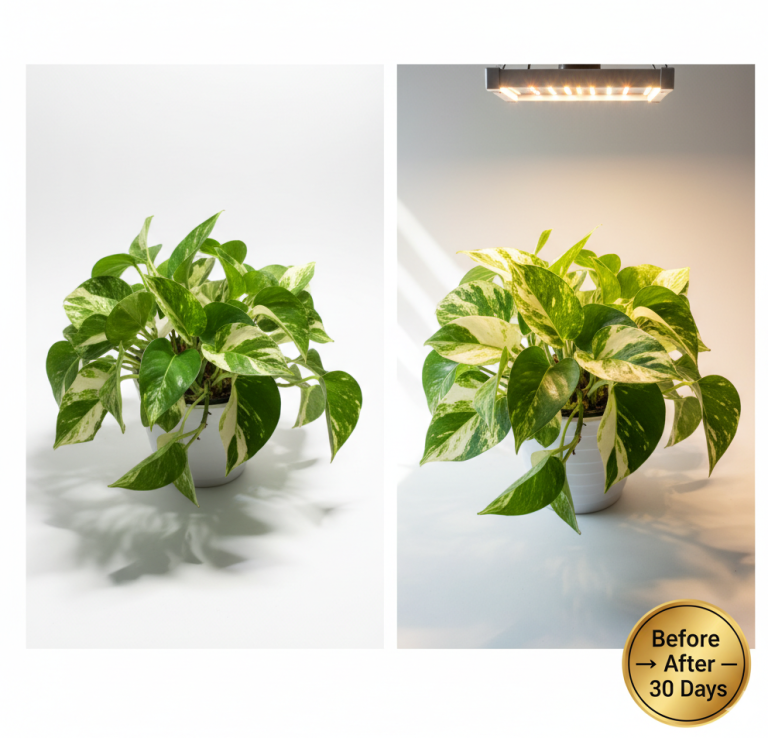
Your friends keep asking how your pothos got so huge and glossy. The secret isn’t some $80 rare fertilizer — it’s an $8 bottle + one weird monthly habit 99% of owners get wrong.
Most people think pothos are “unkillable,” so they just water and forget.
Result?
Leggy vines, fading variegation, tiny new leaves, and a plant that’s slowly starving in its pot.
In this guide I’ll show you the exact fertilizer, dilution, and schedule that turns sad pothos into lush, trailing monsters — without ever burning a single root.
Let’s make your living room look like a jungle.
The Science of Pothos Nutrition (The “Why”)
Why Your Pothos Needs More Than Just Water
To understand fertilization, you have to understand the environment we are working with. In the wild, a Pothos vine trails along the nutrient-dense forest floor or climbs up trees.
It is constantly fed by decaying leaves, insect waste, and rain that washes minerals down from the canopy. It is an open ecosystem with a continuous buffet of nutrients.
Your potted plant lives in a “closed system.” The soil in the pot contains a finite amount of nutrients. Once the plant consumes those minerals to build its cell walls and chlorophyll, they are gone.
Water does not replace them; in fact, excessive watering can actually flush remaining nutrients out of the drainage holes.
If you do not replenish these minerals artificially through fertilizer, the plant begins to cannibalize itself. It will drain energy from older leaves to support new growth, leading to that classic look where the bottom of the vine is bare and yellow while the tip is green but weak.
Decoding the NPK Ratio
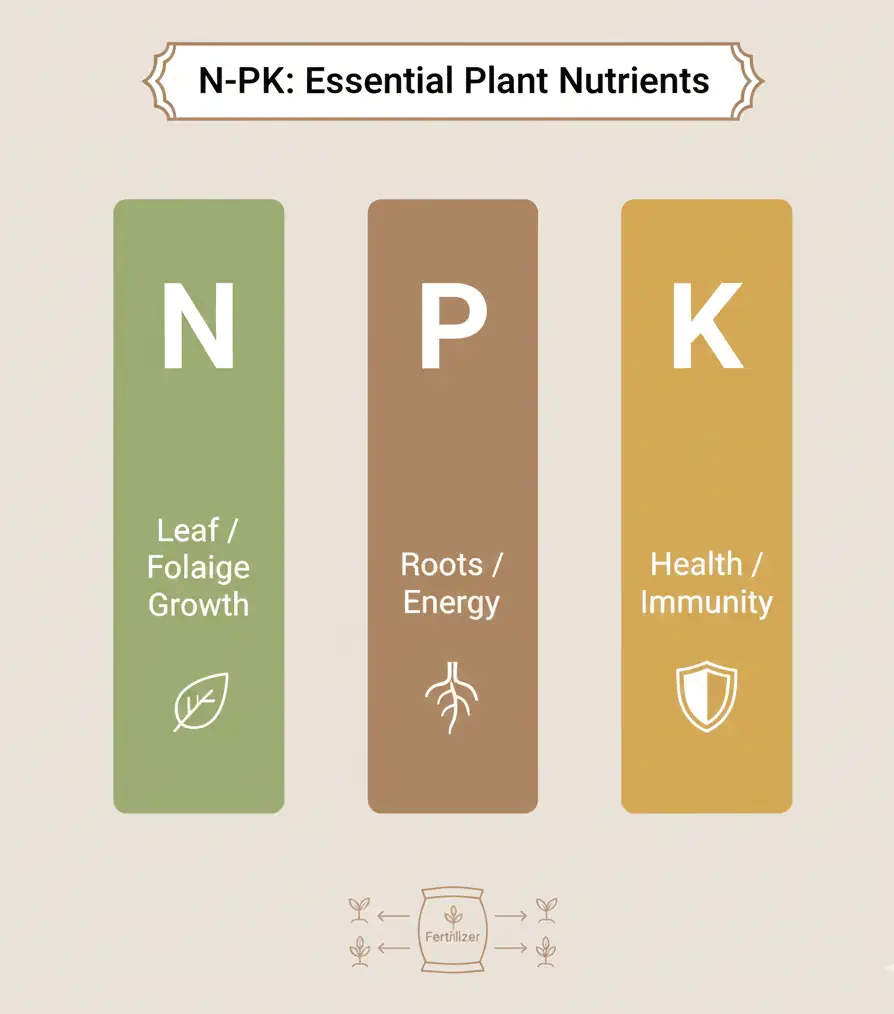
When you look at a bottle of fertilizer, you will see three numbers separated by hyphens, such as 10-10-10 or 5-1-1. This is the N-P-K ratio. Understanding this code is the difference between a plant that explodes with growth and one that burns.
What do the Numbers Mean?
These elements are the “macronutrients” required for plant survival:
Nitrogen (N): The Foliage Builder
This is the most critical number for Pothos owners. Nitrogen is the primary component of chlorophyll, the green pigment responsible for photosynthesis.
It drives leafy, vegetative growth. Since we grow Pothos for their leaves, not their flowers or fruit, Nitrogen is our priority.
Phosphorus (P): The Root & Energy Driver
Phosphorus is essential for root development and the transfer of energy within the plant structure. It helps the plant build a strong foundation to support those long vines.
Potassium (K): The Health Defender
Think of Potassium as the plant’s immune system booster. It regulates water uptake, aids in enzyme activation, and makes the plant more resistant to disease and temperature stress.
The Ideal Ratio for Pothos
So, what is the magic number for Epipremnum aureum?
Because Pothos are foliage plants, we are not trying to encourage blooming. Therefore, we do not need massive amounts of Phosphorus.
I recommend a balanced ratio (like 10-10-10 or 20-20-20) or a formula slightly higher in Nitrogen (like 3-1-2).
My Expert Recommendation: Look for a balanced liquid fertilizer (10-10-10) or one specifically formulated for “Foliage Plants.” Avoid “Bloom Boosters” which have a high middle number (e.g., 10-30-10), as these will not benefit your Pothos and can lead to salt buildup.
Choosing Your Weapon: Types of Fertilizers
Not all plant food is created equal. The delivery method matters just as much as the nutrient content. Here is how the different types stack up for indoor care.
Liquid vs. Granular vs. Slow-Release
Liquid Fertilizers (The Instant Fix)
Liquid fertilizers are concentrates that you dilute into your watering can.
- Pros: The roots absorb the nutrients almost immediately. You have total control over the dosage, allowing you to dilute it further for sensitive plants.
- Cons: They flush out of the soil relatively quickly, meaning you need to apply them more frequently (usually every 2 to 4 weeks).
- Verdict: This is my personal favorite for Pothos because it allows for precision. If the plant looks stressed, I can stop immediately.
Slow-Release Pellets (The “Set and Forget”)
These are small resin-coated balls that release nutrients over time as they get wet.
- Pros: Extremely low maintenance. One application lasts 3 to 6 months.
- Cons: You have zero control once they are in the soil. If you accidentally over-fertilize, you cannot “take it back” without repotting the entire plant. They also tend to release unevenly; releasing too much in hot weather and not enough in cool weather.
- Verdict: Good for office plants or high-volume collections where weekly maintenance is impossible.
Granular Fertilizers
These are loose, dry grains often used for outdoor lawns or vegetable gardens.
- Warning: Generally, granular fertilizers are too harsh for tropical houseplants. The concentration is often too high and can burn the sensitive roots of a Pothos in a confined pot. Avoid these for indoor use.
Synthetic vs. Organic Options
The debate between synthetic (chemical) and organic fertilizers is ongoing. Here is the breakdown to help you decide:
| Feature | Synthetic Fertilizers | Organic Fertilizers |
|---|---|---|
| Source | Chemically manufactured minerals | Plant/Animal matter (seaweed, manure, worm castings) |
| Speed | Fast-acting. Nutrients are available instantly. | Slow-acting. Must be broken down by soil bacteria first. |
| Precision | Exact NPK ratios (e.g., exactly 20-20-20). | Variable nutrient levels depending on the batch. |
| Risk | Higher risk of “burning” roots if overdosed. | Very low risk of burn; “gentle” feed. |
| Soil Health | Does nothing for soil structure; can kill beneficial microbes over time. | Improves soil structure and encourages beneficial microbial life. |
| Smell | Usually odorless. | Can have an earthy or fishy odor (especially fish emulsion). |
My Strategy: I use a synthetic liquid fertilizer in the spring to give the plant a strong “wake up” boost after winter. Then, I switch to organic options (like fish emulsion or liquid kelp) for the rest of the growing season to maintain soil health and provide micronutrients.
The “When”: Timing is Everything
Fertilizing a Pothos at the wrong time is worse than not fertilizing it at all. You must align your feeding schedule with the plant’s natural growth cycle.
The Pothos Growing Schedule
Spring and Summer (The Active Phase)
As the days get longer and sunlight intensifies, your Pothos enters its metabolic high gear. It is actively pushing out new leaves and extending vines.
- Action: This is when you feed.
- Frequency: Apply liquid fertilizer every 2 to 4 weeks. If using slow-release, apply once at the start of spring.
Fall and Winter (Dormancy)
In the Northern Hemisphere, light levels drop significantly from October through March. Even indoors, your plant “knows” it is winter. Its growth slows down or stops completely.
- Crucial Advice: Stop fertilizing.
- Why? The plant’s metabolism has slowed. It cannot process the nutrients you are pouring in. These unused chemicals sit in the soil, crystallize into salts, and burn the roots.
- Exception: If you use high-powered grow lights that simulate 12+ hours of summer sun year-round, you can continue to fertilize at a reduced rate (1/4 strength).
The “New Plant” Rule
Did you just bring a Pothos home from the garden center? Do not fertilize it.
Commercial growers pump plants full of slow-release fertilizer pellets to make them look lush for the sale.
Those pellets are likely still in the soil and active. Adding more food now will cause a toxicity overdose. Wait 4 to 6 months after buying a plant (or repotting it with fresh premium soil) before you start your own feeding regimen.
Step-by-Step Guide: How to Fertilize Pothos Effectively
Here is the precise protocol I use for my specimen plants.
The Liquid Fertilizer Method (Precision Approach)
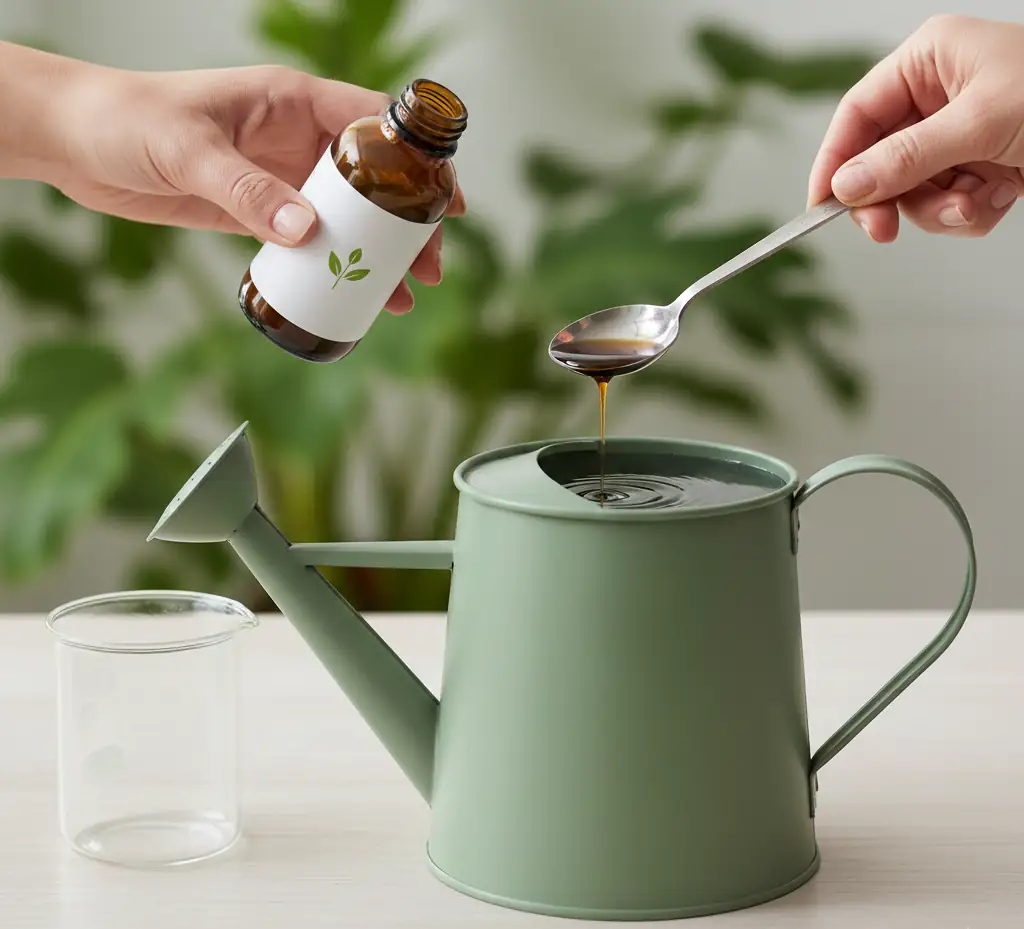
- Check Soil Moisture: Never fertilize a bone-dry plant. If the soil is pulled away from the edges of the pot and completely dry, the fertilizer will rush straight to the roots and shock them. Water the plant lightly with plain water first to dampen the soil.
- The Dilution: Read the instructions on your bottle, then cut the dose in half. Manufacturers often recommend the maximum possible dose to sell more product. Pothos are not heavy feeders like tomatoes; they prefer a lighter diet. If the bottle says “1 teaspoon per gallon,” use 1/2 teaspoon.
- The Application: Pour the fertilizer solution evenly over the soil surface. Do not just dump it in one spot. Ensure you pour enough so that water runs freely out of the drainage holes. This “flush” ensures that the solution reaches all roots and helps wash away old salt deposits.
- Drain: Let the pot drain completely in the sink or bathtub. Never let the plant sit in a saucer of fertilizer water, as this can cause root rot and re-absorption of salts.
The Slow-Release Method (Low Maintenance)
- Prep the Soil: Use a chopstick or your finger to gently agitate and loosen the top inch of soil.
- Measure: Check the package for the correct amount based on your pot size (e.g., 1 tablespoon for a 6-inch pot).
- Apply: Sprinkle the pellets evenly around the base of the plant. Avoid piling them against the main stem, as this can cause localized rotting.
- Activate: Water the plant thoroughly. The pellets need moisture to begin breaking down and releasing nutrients.
The Foliar Feeding Technique
Can Pothos eat through their leaves? Yes. Plants have microscopic pores on their leaves called stomata. While roots are the main dining room, leaves can absorb nutrients for a quick boost.
- Recipe: Mix a very weak solution of liquid fertilizer (1/4 strength) or liquid kelp in a spray bottle.
- Application: Mist the leaves liberally, including the undersides where stomata are most abundant.
- Note: This is a supplement, not a meal replacement. It is great for quickly greening up a plant that looks a bit pale, but it does not support structural growth like root feeding does.
Natural and DIY Pothos Fertilizers (Fact vs. Fiction)
The internet is full of “kitchen scrap hacks” for plants. Some are brilliant; others are dangerous. Let’s separate the science from the myths.
Coffee Grounds
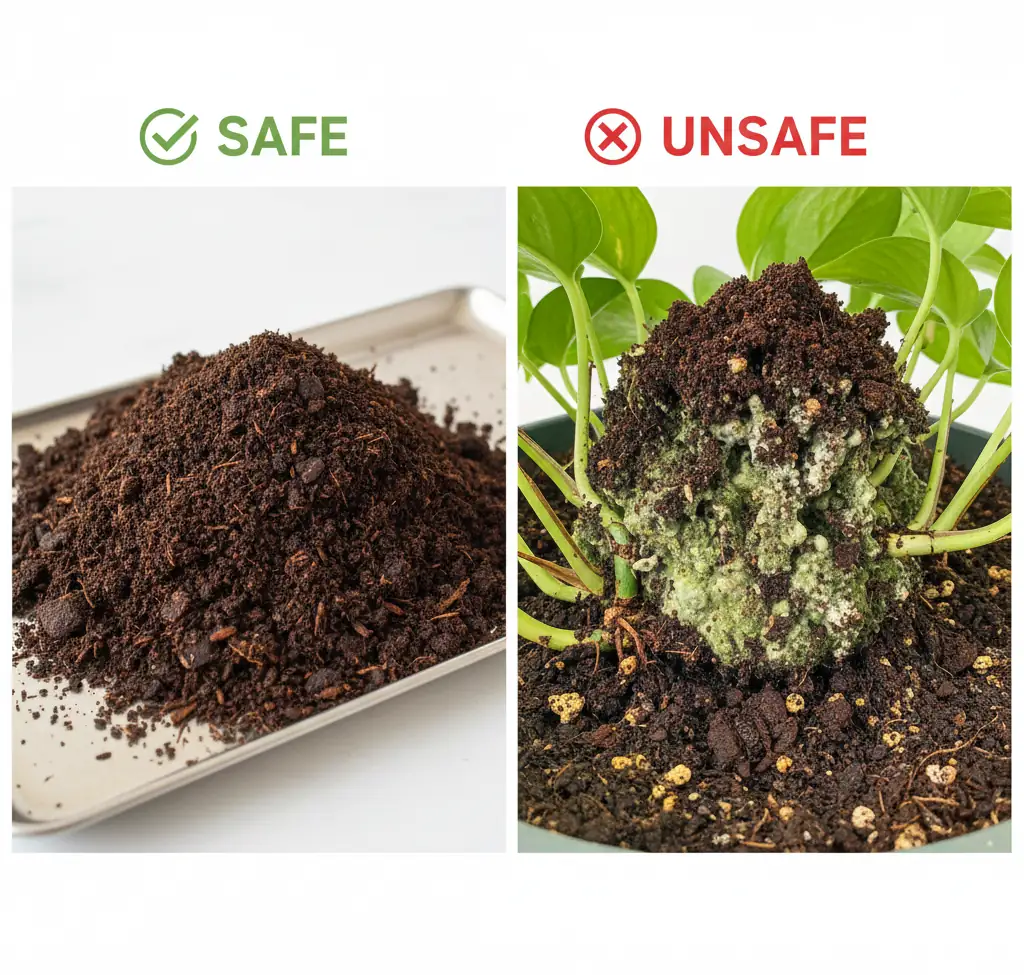
- The Theory: Coffee is high in Nitrogen.
- The Reality: Coffee grounds are highly acidic and can retain too much moisture, leading to mold on the soil surface. Putting fresh grounds directly in your pot can skew the pH and lock out other nutrients.
- Verdict: Compost them first. Do not put them directly on your indoor Pothos.
Banana Peels
- The Theory: High in Potassium.
- The Reality: Whole peels take months to rot and will attract fungus gnats to your home. Soaking peels in water to make “banana tea” provides some potassium, but it is a very weak source compared to a real fertilizer.
- Verdict: Harmless, but mostly ineffective.
Eggshells
- The Theory: Calcium for strong cell walls.
- The Reality: Eggshells are great, but they take years to decompose.
- Verdict: Crush them into a fine powder or dust. They act as a slow-release calcium supplement and can help buffer soil acidity.
Aquarium Water: The Secret Weapon
If you have a freshwater fish tank, you are sitting on a goldmine.
- The Science: Fish waste is rich in ammonia (Nitrogen) and beneficial bacteria.
- Verdict: This is the best DIY fertilizer available. Next time you change your tank water, use the dirty water on your Pothos. It is mild, organic, and plants absolutely love it.
Troubleshooting: Signs You’re Doing It Wrong
Plants communicate their health through their leaves. You just need to learn the language.
Recognizing Nutrient Deficiencies
If you haven’t fertilized in a year, look for these signs:
- Pale/Yellowing Older Leaves: The plant is stealing Nitrogen from the old leaves to build new ones. This is a classic Nitrogen deficiency.
- Purple Tint to Stems/Leaves: This is often a sign of Phosphorus deficiency.
- Brown, Crispy Edges: While often humidity-related, this can also signal a Potassium deficiency.
The Danger Zone: Fertilizer Burn
It is much easier to kill a Pothos with too much fertilizer than too little.
Symptoms:
- Brown, “scorched” leaf tips and margins.
- Sudden yellowing of lower leaves.
- A white, crusty buildup on the soil surface or around the rim of the pot.
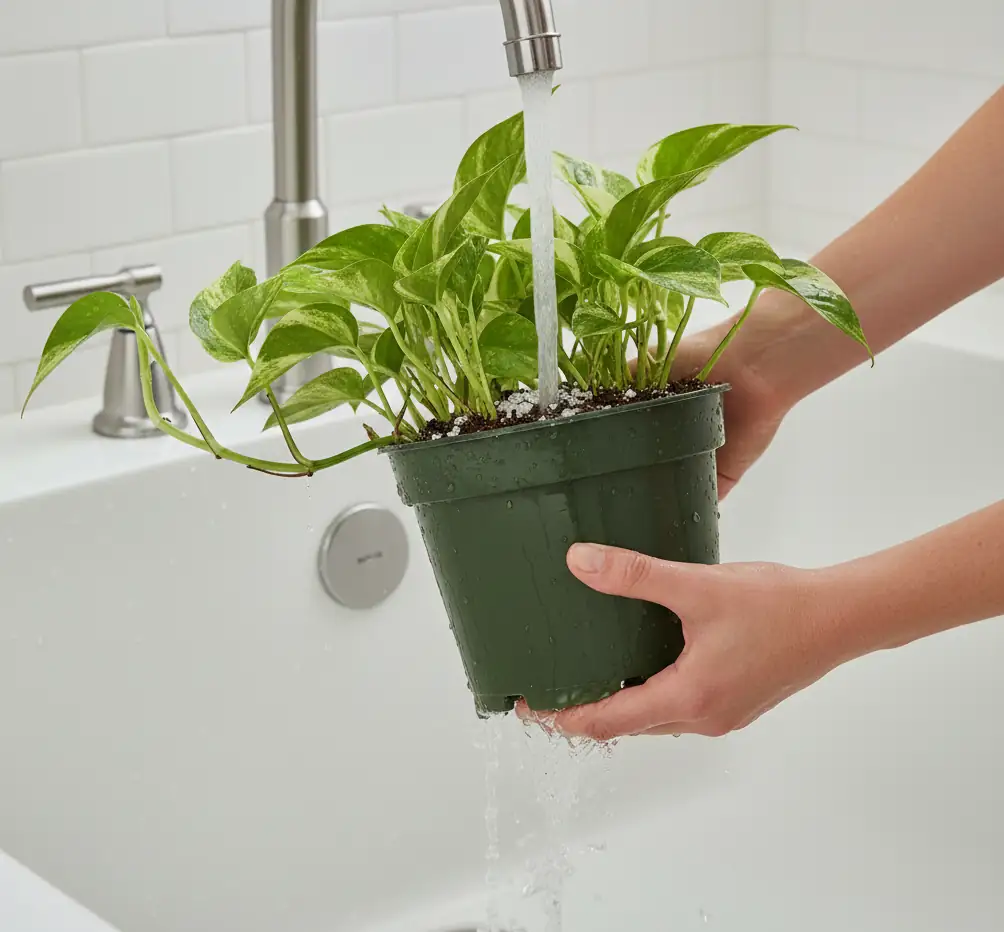
The Fix: Leaching the Soil
If you suspect burn, you must wash the salts out immediately.
- Place the plant in a sink or shower.
- Run lukewarm water through the soil continuously for 3 to 5 minutes. You want to wash the soil volume several times over.
- Allow it to drain fully.
- Do not fertilize again for at least 6 weeks.
Advanced Care: Soil pH and Water Quality
For the Fortune 500-level gardener, we look beyond the fertilizer bottle to the chemistry of the water and soil itself.
The Hidden Variable: Soil pH
Pothos prefer a slightly acidic soil, with a pH between 6.1 and 6.5. If your soil becomes too alkaline (above 7.0) or too acidic (below 5.5), the chemical bonds change, and nutrients become “locked out.” You could be pouring fertilizer in, but the plant physically cannot access it.
Over time, synthetic fertilizers tend to lower soil pH (make it more acidic). If you have been fertilizing the same plant in the same pot for years, the soil might be too acidic.
- Solution: Repot with fresh potting mix every 12 to 18 months to reset the pH balance.
Water Quality Matters
In the USA, tap water often contains chlorine, chloramines, and fluoride.
- Chlorine: Can kill the beneficial microorganisms in organic fertilizers.
- Fluoride: Pothos can be sensitive to fluoride accumulation, which causes brown tip necrosis.
- Recommendation: If you are serious about pristine foliage, fill your watering can and let it sit open for 24 hours to allow chlorine to evaporate (off-gas). For the absolute best results, use distilled or rainwater.
Frequently Asked Questions About Pothos Feeding
Can I fertilize pothos after propagating?
No. Wait until the cuttings have developed a robust root system and have been transplanted into soil. Roots grown in water are fragile; fertilizer salts will burn them instantly. Once in soil, wait 4 to 6 weeks before the first light feeding.
Is Miracle-Gro good for pothos?
Yes, standard Miracle-Gro All Purpose Plant Food works, but it is very strong. Use the “Indoor Plant” specific formula if possible. If using the blue crystals, dilute it to half the recommended strength to prevent salt buildup.
Why are my pothos leaves turning yellow after fertilizing?
This is likely fertilizer burn. You may have used a concentration that was too strong, or applied it to dry soil. Flush the soil with water immediately to remove the excess salts.
How do I make my pothos grow huge leaves?
Fertilizer helps, but it is not the only factor. To get giant, fenestrated leaves (like those in the wild), the plant needs a moss pole to climb and high humidity. Fertilizer fuels the growth, but the climbing structure triggers the hormone change for larger leaves.
Conclusion
Fertilizing your Pothos is the bridge between simply keeping a plant alive and cultivating a piece of the jungle in your home. By understanding the “why” behind NPK ratios and adhering to the seasons, you empower your plant to reach its genetic potential.
Remember the three Golden Rules:
- Nitrogen Focus: Stick to balanced or foliage-focused formulas.
- Respect the Seasons: Feed in summer, rest in winter.
- Less is More: Always dilute. You can always add more later, but you cannot take it out.
References & Further Reading
- University of Florida IFAS Extension: Epipremnum aureum Production Guide.
- Clemson Cooperative Extension: Indoor Plants – Cleaning and Feeding.
- Penn State Extension: Caring for Houseplants.